
Kepler’s Laws of Planetary Motion
📚 Key Concept
🔹 Real-Life Example: Orbits of Planets and Satellites
Mars takes about 687 Earth days to orbit the Sun, while Mercury takes only 88 days because it’s closer. Similarly, the International Space Station orbits Earth every 90 minutes, while geostationary satellites take 24 hours due to their higher altitude.
A set of three scientific laws discovered by Johannes Kepler that describe the motion of planets around the Sun.
🔹 The Three Kepler’s Laws Explained
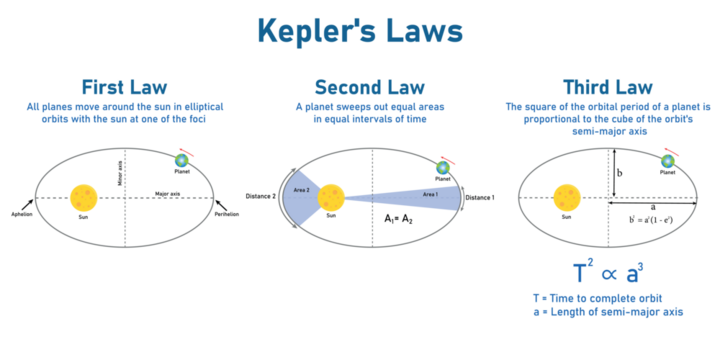
- Law 1 – Law of Ellipses: All planets move in elliptical orbits with the Sun at one focus.
- Law 2 – Law of Equal Areas: A line joining a planet to the Sun sweeps out equal areas in equal intervals of time.
- Law 3 – Law of Periods: The square of the orbital period of a planet is directly proportional to the cube of the semi-major axis of its orbit.
🧪 Important Formulas
🔸 Mathematical Expression
T² ∝ R³
- T = Orbital period
- R = Semi-major axis of orbit
🔹 Real-World Observations Using Kepler’s Laws
- Earth moves faster in January (when it’s closer to the Sun) than in July
- Comets speed up as they approach the Sun
- Satellite orbital periods change based on their altitude
🔍 Advanced: Applications in Satellite Orbiting & Space Missions
Modern space missions use Kepler’s Laws to:
- Calculate fuel needs for orbital transfers
- Time spacecraft launches to reach other planets accurately
- Design satellite constellations for GPS and communications
🧠 Practice Question