
Free Fall and Acceleration Due to Gravity (g)
📚 Key Concepts
🔹 Real-Life Example: Feather vs Hammer on the Moon
Drop a feather and a hammer from the same height in a vacuum (like on the Moon), and they hit the ground at exactly the same time! This shows that all objects fall with the same acceleration regardless of mass. On Earth, the feather falls slower due to air resistance, but the gravitational pull is still the same.

🔹 Free Fall: The motion of an object under the influence of gravitational force only.
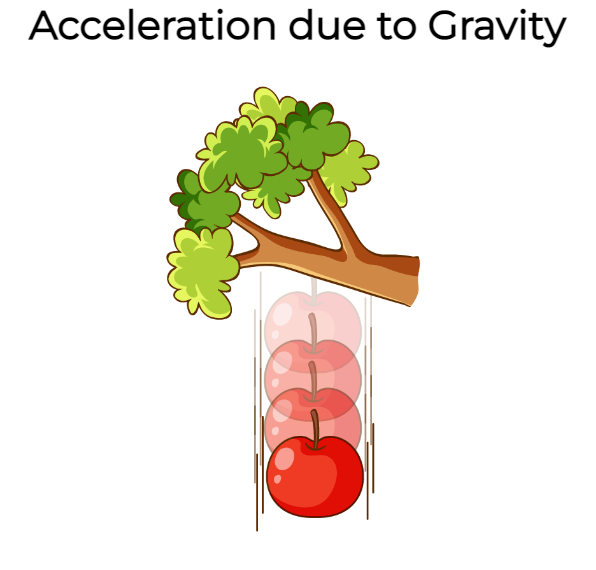
🔹 Acceleration Due to Gravity
- Value: g = 9.8 m/s² (or more precisely, 9.81 m/s²)
- Direction: Always directed toward the center of Earth
- Nature: Nearly constant near Earth’s surface
🧪 Important Formulas
🔸 Formula Derivation for g
From Newton’s Law of Gravitation: F = GMm/R²
From Newton’s Second Law: F = mg
Equating both: mg = GMm/R²
Simplifying: g = GM/R²
- G: Universal gravitational constant
- M: Mass of Earth
- R: Radius of Earth
🔍 Advanced: Difference Between ‘g’ and ‘G’
- g: Acceleration due to gravity (9.8 m/s²) – varies slightly with location and altitude
- G: Universal gravitational constant (6.674 × 10⁻¹¹ Nm²/kg²) – constant everywhere in the universe