Kinetic Energy

📚 Key Concepts of Kinetic Energy
🔹 Real-Life Example
A moving car has kinetic energy — the faster it moves, the more energy it has. This is why high-speed crashes are more dangerous than low-speed ones.
A bullet’s devastating impact comes from its high kinetic energy despite its small mass. Fan blades spinning at high-speed store significant kinetic energy.
Kinetic Energy: The energy possessed by an object due to its motion.
🧪 Important Formulas
🔸 Kinetic Energy Formula
KE = ½mv²
Where:
- KE = Kinetic energy (J)
- m = Mass of object (kg)
- v = Velocity of object (m/s)
🔹 Key Observations
- KE is directly proportional to mass
- KE is directly proportional to the square of velocity
- Doubling velocity quadruples the kinetic energy
- KE is always positive (since v² is always positive)
🔍 Advanced: Kinetic Energy and Momentum Relationship
KE = p² / 2m, where p = momentum = mv
This equation shows the mathematical relationship between kinetic energy and momentum.
🔹 Examples of Kinetic Energy
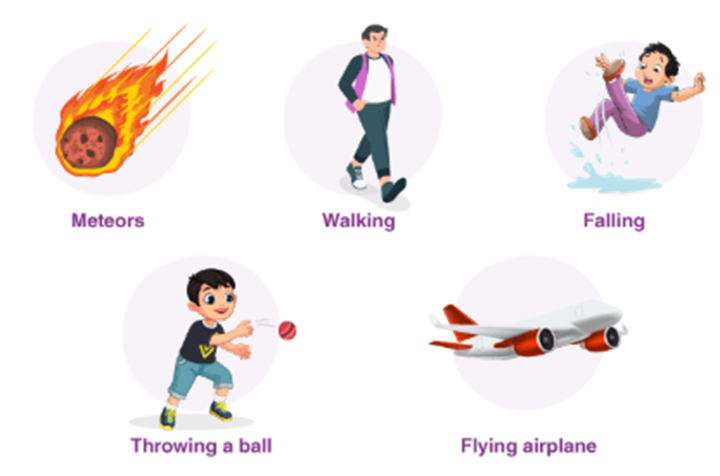
- Moving vehicles: Cars, trains, airplanes
- Flowing water: Rivers, ocean currents
- Moving air: Wind energy
- Rotating objects: Spinning wheels, gyroscopes