
Motion – Class 9 Science
🟦 📝 Introduction to Motion
Motion is defined as the change in the position of an object with respect to time. Whether it’s a car on the road, the Earth revolving around the sun, or a ball rolling on the floor — everything that changes position is in motion.
🟩 📏 Distance vs DisplacementDistance
Total path covered (Scalar Quantity)
Displacement – Shortest path between two points (Vector Quantity)
✅ Example:
If you walk 10 m forward and 10 m back,
- Distance = 20 m
- Displacement = 0 m

Displacement can be zero even if distance is not!
⚡ Speed, Average Speed & Velocity
| Term | Formula | Type |
|---|---|---|
| Speed | Distance / Time | Scalar |
| Average Speed | Total Distance / Total Time | Scalar |
| Velocity | Displacement / Time | Vector |
🎯 Note: Speed ≠ Velocity always. Direction matters in velocity!
🌀 Acceleration & Retardation
- Acceleration = Change in velocity / Time
- Uniform Acceleration: Constant change
- Retardation: Negative acceleration (decreasing speed)
🧠 Note: Acceleration is a vector quantity.
📊 Graphical Representation of Motion
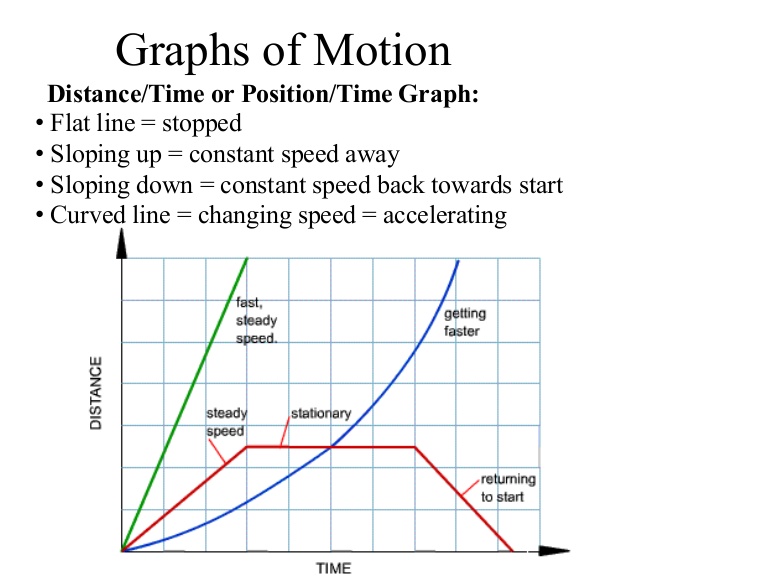
📈 Distance-Time Graphs
- Straight Line = Uniform motion
- Curved Line = Non-uniform motion
📉 Velocity-Time Graphs
- Horizontal = Constant velocity
- Sloped = Acceleration
- Area under graph = Distance covered
🧮 Equations of Motion (Uniform Acceleration)
v = u + at
s = ut + ½at²
v² = u² + 2as
Where:
v = final velocity
u = initial velocity
a = acceleration
s = displacement
t = time
🧠 These can also be derived using velocity-time graphs!
🔁 Uniform Circular Motion
Even if speed is constant, direction keeps changing.
So velocity is changing → motion is accelerated.
Examples:
- Earth around Sun
- Athlete on circular track
- Second hand of a watch
📌 Formula: Speed = 2πr / T
🧠 Practice Numericals
- Speed problems
- Displacement with direction
- Graph-based numericals
- Acceleration cases
📘 PYQ Tag: (CBSE 2020) – “A car covers 20 m in 4 s. What is its speed?”
🎯 Key Takeaways Summary
- Motion = Change in position over time
- Distance ≠ Displacement
- Speed is scalar, velocity is vector
- Acceleration can be positive or negative
- Graphs help visualize motion
- Equations are used in solving real-world problems