
Law of Conservation of Energy
📚 Key Concepts of Conservation of Energy
🔹 Real-Life Example
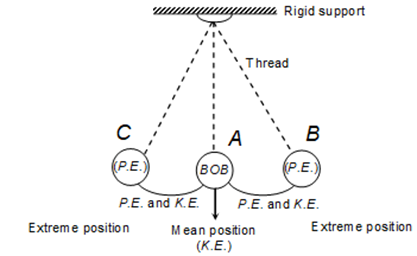
A pendulum swings back and forth, constantly converting between kinetic and potential energy.
At the highest point, all energy is potential (KE = 0), and at the lowest point, all energy is kinetic (PE = 0).
Total mechanical energy remains constant (ignoring air resistance and friction).
Law of Conservation of Energy: Energy can neither be created nor destroyed; it can only be transformed from one form to another. The total energy of an isolated system remains constant.
🧪 Important Formulas
🔸 Conservation Equation
Total Energy = Constant
KE + PE = Constant (for mechanical energy)
½mv² + mgh = Constant
🔹 Applications
- Freely Falling Body:
- At height h: KE = 0, PE = mgh
- At ground: KE = ½mv², PE = 0
- Total energy: mgh = ½mv²
- Pendulum Motion:
- At extreme positions: Maximum PE, Zero KE
- At mean position: Maximum KE, Zero PE
- Total energy remains constant

🔍 Advanced: Energy Conservation in Real Systems
In real systems, mechanical energy may appear to decrease due to:
- Friction: Converts to heat
- Air resistance: Converts to heat
- Sound: Energy converts to sound waves
But total energy (including heat, sound, etc.) is still conserved.
🔹 Examples of Energy Conservation
- Roller coaster: PE ↔ KE throughout the ride
- Bouncing ball: KE ↔ PE ↔ Elastic PE
- Satellite orbit: KE ↔ PE as it moves in elliptical orbit
- Simple harmonic motion: KE ↔ PE in springs, pendulums