
Archimedes’ Principle
📚 Key Concepts
🔹 Real-Life Example: Ships made of steel float on water despite being denser than water. This is because the ship displaces a volume of water whose weight equals the ship’s weight. Submarines adjust buoyancy by filling or emptying ballast tanks with water, thereby changing their density.
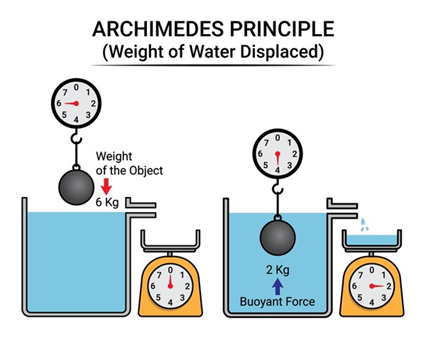
🔹 Archimedes’ Principle: When a body is partially or fully immersed in a fluid, it experiences an upward force equal to the weight of the fluid displaced by it.
🧪 Important Formulas
- 🔸 Mathematical Expression:
Buoyant Force = Weight of Displaced FluidFb = ρ(fluid) × V(displaced) × g
Where:- Fb = Buoyant force (N)
- ρ(fluid) = Density of fluid (kg/m³)
- V(displaced) = Volume of displaced fluid (m³)
- g = Acceleration due to gravity (m/s²)
🔹 Applications of Archimedes’ Principle
- 🚢 Ships: Displace water equal to their weight to float
- 🔧 Submarines: Adjust buoyancy with ballast tanks
- 🧪 Hydrometers: Float at different levels to measure fluid density
- 🧊 Icebergs: Approximately 90% underwater and 10% visible

🔍 Advanced: Density and Upthrust Relationship
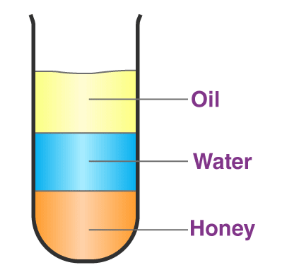
- Object density < fluid density: Object floats
- Object density = fluid density: Object remains suspended
- Object density > fluid density: Object sinks
🔬 Experiment to Demonstrate Archimedes’ Principle
- Place an object in water and measure the following:
- 1️⃣ Weight of object in air
- 2️⃣ Weight of object in water
- 3️⃣ Difference in weight = Buoyant force = Weight of displaced water