Pressure in Fluids + Buoyancy

📚 Key Concepts
🔹 Real-Life Example
When you dive into a swimming pool, you feel pressure increasing in your ears as you go deeper. Deep-sea divers experience enormous pressure – at 10 meters depth, pressure doubles! This is why submarines need thick walls and why your ears “pop” when changing altitude in airplanes.
🔹 Fluid Pressure: The pressure exerted by a fluid at rest on any surface in contact with it.
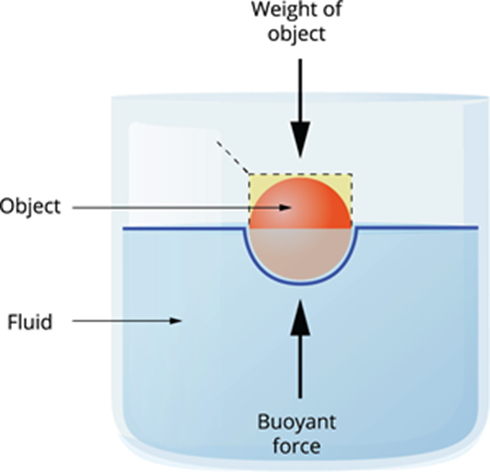
Buoyant Force: The upward force exerted by a fluid on an object immersed in it.
🧪 Important Formulas
🔸 Pressure in Fluids
- Increases with depth: P = ρgh
- Acts in all directions: Pressure is exerted equally in all directions
- Independent of container shape: Depends only on depth
🔹 Pascal’s Principle
Pascal’s Law: Pressure applied to a confined fluid is transmitted equally throughout the fluid in all directions.
🔹 Buoyancy
When an object is immersed in a fluid, it experiences an upward force called buoyant force.
🔍 Advanced: Pressure Formula
P = hρg
Where:
- P = Pressure (Pa)
- h = Depth (m)
- ρ = Density of fluid (kg/m³)
- g = Acceleration due to gravity (m/s²)
🔹 Activity: Why Ears Hurt Deep Underwater
As depth increases, water pressure increases proportionally. Our eardrums experience this pressure difference between inside and outside the ear, causing pain and potential damage.