
Universal Law of Gravitation
📚 Key Concepts
🔹 Real-Life Example of Gravitation
When you drop your phone, it falls to the ground. When the Moon orbits Earth, it’s constantly “falling” toward Earth but never hits it due to its horizontal velocity. Even distant galaxies are attracted to each other across billions of light-years. This universal attraction keeps our solar system together and governs the motion of planets, satellites, and even the formation of stars.
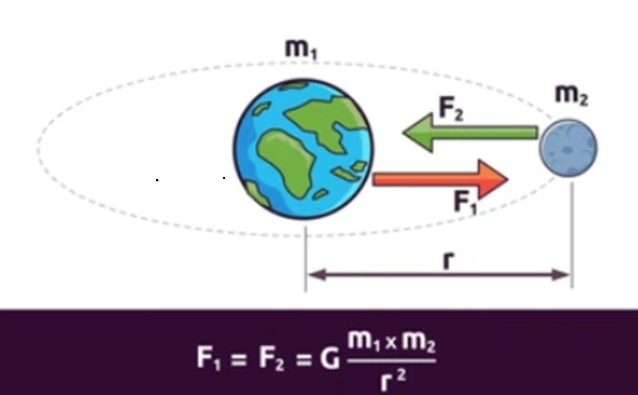
Newton’s Universal Law of Gravitation: Every object in the universe attracts every other object with a force which is directly proportional to the product of their masses and inversely proportional to the square of the distance between their centres.
🧪 Important Formulas
🔸 Gravitational Force Formula
F = G × m₁ × m₂ / r²
- F = Gravitational force (N)
- G = Universal gravitational constant (6.674 × 10⁻¹¹ Nm²/kg²)
- m₁, m₂ = Masses of the two objects (kg)
- r = Distance between their centres (m)
🔹 Importance in Daily Life and Space
- Keeps us anchored to Earth’s surface
- Governs tidal movements in oceans
- Controls satellite orbits and space missions
- Determines planetary motions and stellar formations
🔍 Advanced View: Gravity on Earth, Moon & Space
This law is truly universal – it works the same whether you’re on Earth (where gravity is 9.8 m/s²), on the Moon (where gravity is about 1/6th of Earth’s), or in space. Massive objects like stars and black holes pull other objects using this same law.
The equation never changes—only the values do!
🧠 Practice: Derivation-Based MCQ