
Equations of Motion
🌟 Introduction to Equations of Motion
What if we could predict exactly where a falling apple will be after 2 seconds? Or calculate how far a car will travel before stopping? The equations of motion are like magical formulas that help us solve these mysteries! These three powerful equations are the keys to understanding motion! 🍎🔮

📸 Visual Concept – Equations of Motion
📚 Key Concepts in Equations of Motion
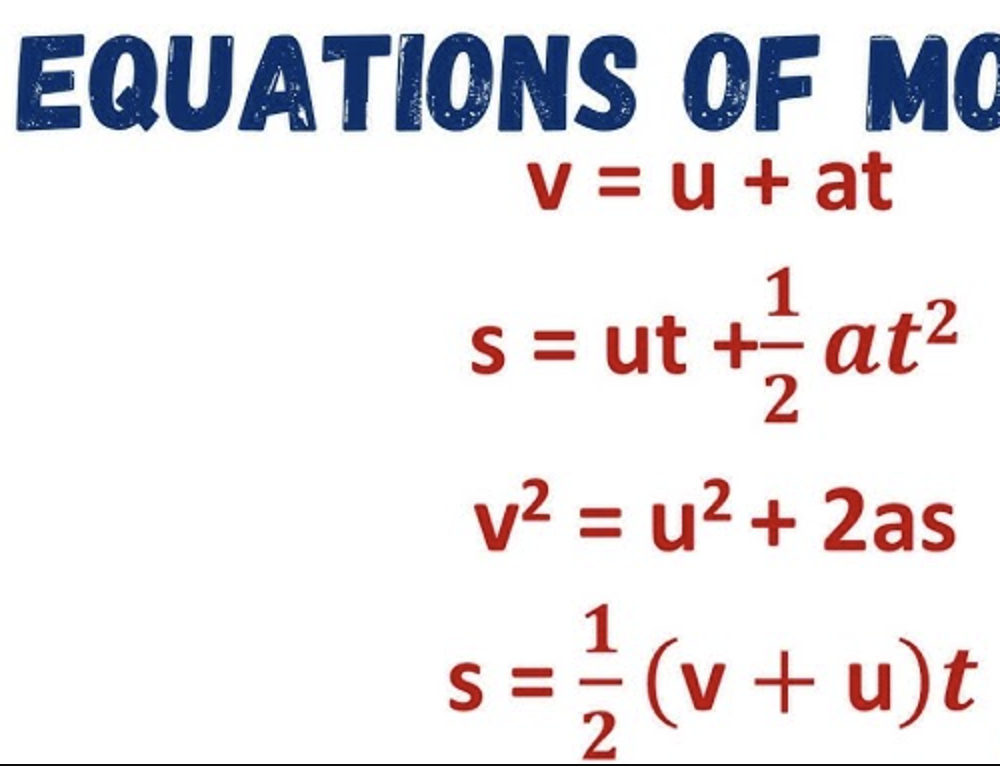
🔹 3 Equations of Uniformly Accelerated Motion
- First Equation: v = u + at
• Links velocity, acceleration, and time
• Used when displacement is unknown - Second Equation: s = ut + ½at²
• Links displacement, initial velocity, acceleration, and time
• Used when final velocity is unknown - Third Equation: v² = u² + 2as
• Links velocities, acceleration, and displacement
• Used when time is unknown
🔸 Variable Reference:
- u = Initial velocity
- v = Final velocity
- a = Acceleration
- t = Time
- s = Displacement
🔹 Sign Conventions
- Positive direction: Usually upward or forward
- Positive acceleration: Speeding up
- Negative acceleration (retardation): Slowing down
⚠️ Common Mistakes to Avoid
- Wrong Sign Convention
- Unit Mismatch (e.g., mixing km/h with m/s)
- Using incorrect equation for given variables
- Calculation mistakes in substitution
- Ignoring physical logic of the answer
🧠 Memory Tricks for Choosing the Right Equation
- VUT: Need Velocity → Use Time Equation (v = u + at)
- SUT: Need Space → Use Time Equation (s = ut + ½at²)
- VUS: Know Velocity & u → Use Space Equation (v² = u² + 2as)
🧠 Important Formulas Recap
- v = u + at
- s = ut + ½at²
- v² = u² + 2as
📊 When to Use Which Equation?
| 🔷 Given Variables | ❓ Unknown | 🧮 Equation to Use |
|---|---|---|
| u, a, t | v | v = u + at |
| u, a, t | s | s = ut + ½at² |
| u, v, a | s | v² = u² + 2as |
| u, v, t | a | a = (v – u)/t |
| u, v, s | a | a = (v² – u²)/2s |