Final Summary + Concept Map

⚖️ Newton’s Laws at a Glance
- First Law (Law of Inertia): Objects resist changes in their state of motion unless acted upon by an external force.
- Second Law (F = ma): The force acting on an object is equal to the mass times its acceleration.
- Third Law (Action-Reaction): For every action, there is an equal and opposite reaction.
📚 Key Concepts Recap
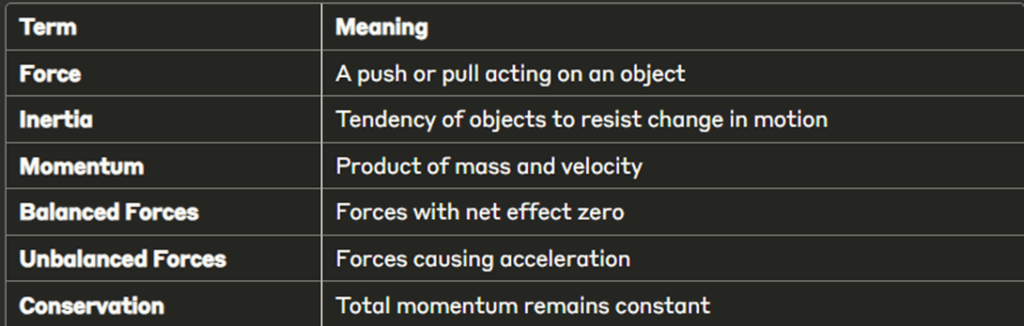
- Force: A push or pull that can change the motion of an object.
- Balanced Forces: Net force = 0; no change in motion.
- Unbalanced Forces: Net force ≠ 0; causes acceleration.
- Momentum: The product of mass and velocity; p = mv
- Conservation of Momentum: In an isolated system, total momentum remains constant.
🧮 Important Formulas Revision
- Newton’s Second Law: F = ma
- Momentum: p = mv
- Weight: W = mg
- Conservation of Momentum: p₁ + p₂ = p₁’ + p₂’
🌍 Real-Life Applications
- Seat belts & Airbags: Increase stopping time, reducing force during accidents.
- Rocket Propulsion: Based on Newton’s Third Law – expelling gases downward pushes the rocket upward.
- Walking & Swimming: Action-reaction forces help move forward.
- Sports: Momentum transfer seen in games like cricket, football, and boxing.
📝 Key Terminology Flashback
- Inertia – Resistance to change in motion
- Acceleration – Rate of change of velocity
- Mass – Quantity of matter in an object
- Velocity – Speed in a particular direction
- Thrust – Force applied in a specific direction (used in propulsion)