
Scientific Method
📚 Key Concepts
🔹 What is Scientific Method?
The scientific method is a step-by-step process that helps us find answers to our questions systematically.
🔍 The Scientific Method Steps:
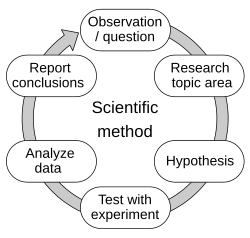
1. Observation
- Notice something interesting or puzzling
- Use all your senses to gather information
- Record what you see, hear, feel, smell, or taste
2. Question Formation
- Ask “why” or “how” about your observation
- Make the question specific and clear
- Focus on one aspect at a time
3. Hypothesis (Educated Guess)
- Propose a possible answer to your question
- Based on existing knowledge and logical thinking
- Should be testable through experiments
4. Experimentation/Testing
- Design and conduct experiments
- Make more observations
- Collect data and evidence
5. Analysis
- Study the results carefully
- Compare with your hypothesis
- Draw conclusions based on evidence
6. Conclusion
- Accept, reject, or modify your hypothesis
- Share your findings
- Ask new questions for further investigation
🔹 The Pen Example Breakdown
Problem: Pen stops writing
Step 1 – Observation: Pen is not making marks on paper
Step 2 – Question: Why did my pen stop writing?
Step 3 – Hypothesis 1: The ink finished
Step 4 – Test: Open pen and check ink refill
Step 5 – Analysis: If empty → hypothesis correct **If not empty → need new hypothesis
Step 6 – New Hypothesis: Ink might have dried up Continue testing…
🔹 Scientific Method in Daily Life
🚲 Bicycle Repair Example:
- Observation: Bicycle tire is flat
- Question: Why is the tire flat?
- Hypothesis: There might be a puncture
- Test: Check for holes or sharp objects
- Analysis: If hole found → puncture confirmed
- Solution: Patch the hole
💡 Electrician Example:
- Observation: Light bulb not working
- Question: What’s wrong with the light?
- Hypothesis 1: Bulb is burnt out
- Test: Replace bulb
- Analysis: If still not working → try new hypothesis
- Hypothesis 2: Problem with switch
- Continue testing…
🍳 Cooking Example:
- Observation: Dal spilled out of cooker
- Question: Why did this happen?
- Hypothesis: Too much water was added
- Test: Check water-to-dal ratio
- Analysis: Compare with successful cooking experiences
🧪 Activity Applications
Activity 1.1: Problem-Solving Experience Think of a recent problem you solved:
- What was the problem?
- What steps did you take?
- How did you test your guesses?
- What was the final solution?
Activity 1.2: Scientific Method in Daily Life Identify situations where scientific method was used:
- At home (cooking, cleaning, organizing)
- At school (solving math problems, finding lost items)
- In sports (improving technique, strategy)
Activity 1.3: Your “Why” Questions List things you wonder about:
- Natural phenomena you’ve observed
- How things work
- Why certain things happen
- Plan how you would find answers